
High Efficiency Solar Energy Cogeneration
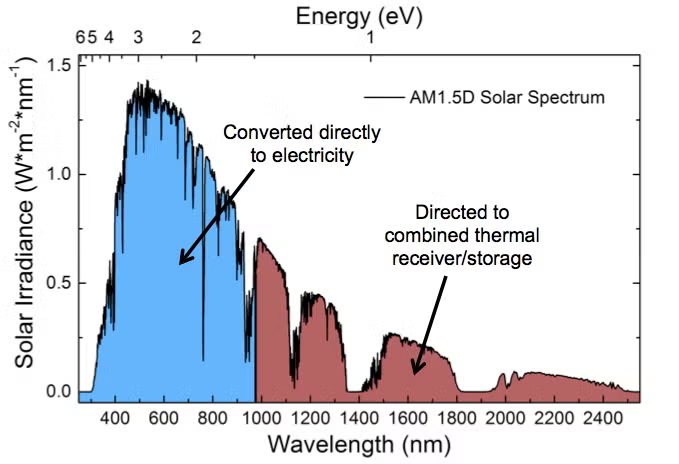


Conventional solar energy conversion techniques have seen tremendous success in recent years, with photovoltaics experiencing significant market penetration in locations across the world, in part due to increases in efficiencies and cost reductions. However, these modules typically convert no more than 25% of incoming solar energy into electricity. Our group is exploring alternative solar energy harvesting architectures that seek to maximize the use of the solar spectrum, enabling significant increases in efficiency at even lower cost.
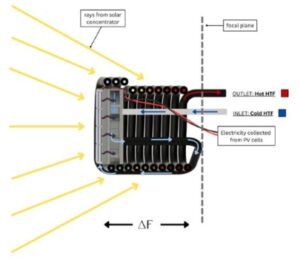
To do this, we are pursuing an approach that utilizes hybrid concentrated photovoltaic and thermal solar energy conversion, generating electricity from high efficiency multi-junction cells in combination with the capture of sunlight as thermal energy, using novel spatial and spectrum splitting approaches. Our innovative receiver technologies keep the solar cells below 100°C while generating thermal energy in the form of hot water at temperatures up to 250°C. The thermal energy can then be stored until the energy is needed. The stored energy can be converted to electricity or may be used directly to provide process heat for a wide range of commercial and industrial users.
Initially funded by DOE’s ARPA-E and in partnership with the University of San Diego, San Diego State University, Boeing-Spectrolab, and Otherlab, the project demonstrated field-validated prototype systems with >85% energy conversion efficiency in a modular and scalable form-factor. Current collaborators include the University of San Diego and ENFRA. Our latest technology generation, the Sunflower Cogen, is pushing towards lower cost and higher durability in a pilot demonstration while maintaining high efficiency cogeneration of electricity and process heat. This technology is currently deployed on a building at Tulane in partnership with ENFRA as a pilot installation generating usable thermal and electric power for building systems.
“The group is exploring alternative solar energy harvesting schemes to maximize use of the full solar spectrum, enabling significant increases in efficiency with potential for lower costs.”